The engineering that moves every order
The core is not one model but four layers running in sequence: they gather the data, read the trend, price the risk, then choose the execution route. What follows explains each layer in turn.
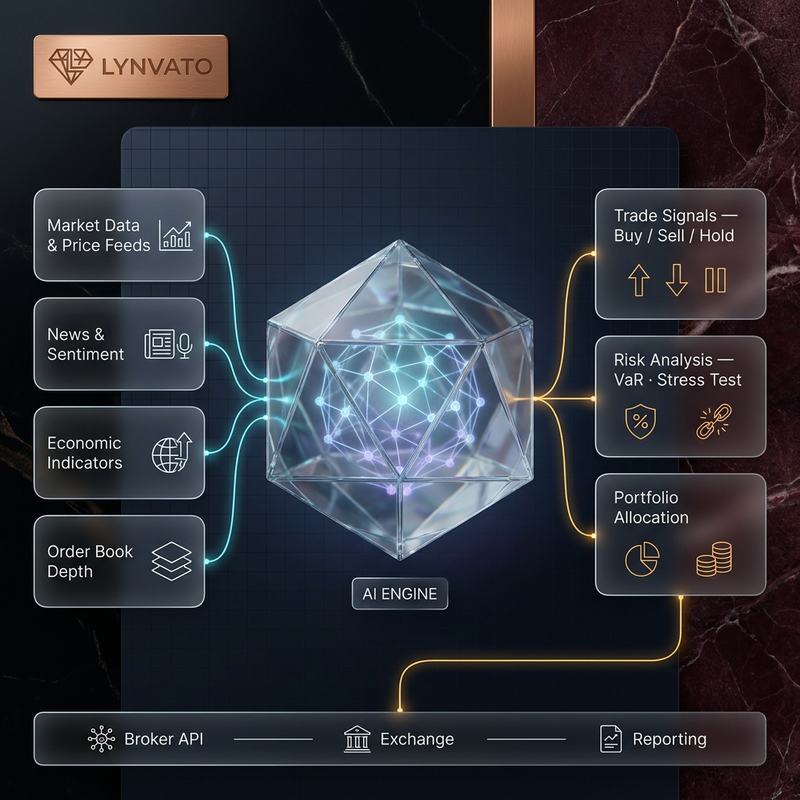
Flow diagram of the Lynvato engine: four feeds on the left — market data and price feeds, news and sentiment, economic indicators, and order-book depth — resolve into three outputs on the right: a trade signal (buy / sell / hold), risk analysis by value at risk and stress test, and portfolio allocation. Execution then passes through the broker API, the exchange and the reporting layer. The labels are the system's own English terms, shown exactly as they appear in the dashboard.

Taking in the data
The first layer pulls prices, volumes and order-book depth from more than fifty venues and normalises them into a single time-aligned stream, so that contradictory sources are never competing over the same decision.
News and economic indicators are layered on top, and the whole stream is rebuilt every hour, so no decision rests on a stale picture of the market.
Six functions running in parallel
Reading the tone of the news
The model reads thousands of headlines and posts a day and reduces their tone to a single number that enters the decision weighting.
Detecting price formations
Continuous matching against historical formations, weighting more heavily those that recurred under comparable liquidity conditions.
Pricing the risk
Estimating the possible loss on each trade before it opens, and testing the position against past stress scenarios.
Choosing the execution route
Splitting the order across the deepest venues to reduce slippage, rather than simply chasing speed.
Scheduled recalibration
Weights are recalibrated on fresh data at regular intervals, so the model never stays captive to a market that has ended.
Quant-desk oversight
No new model goes live without human review, and any model can be halted the moment its behaviour leaves the monitored bounds.

Execution and protection
Once the decision resolves, the order leaves in 1.7 milliseconds on average, from servers sited close to exchange nodes, with an automatic loss cap attached to every position.
The assets themselves stay off the execution path: 96% sit in cold wallets isolated from the network, and client money is held entirely apart from the firm's operating accounts.
Put the algorithm to work for you
Join thousands of traders across the Gulf who run their portfolios through Lynvato.
Join Now